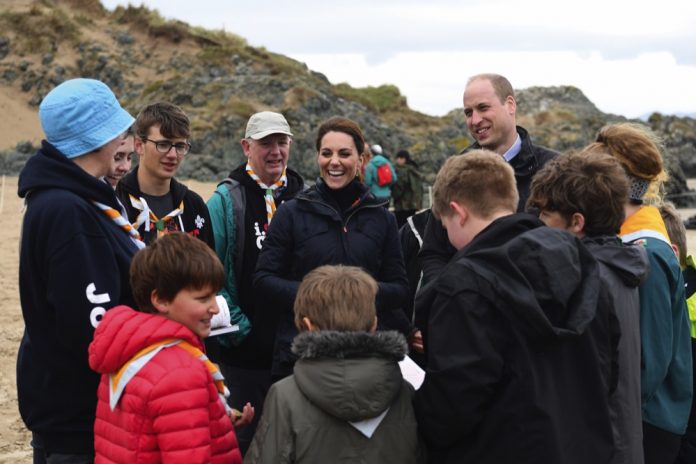
The Duke and Duchess of Cambridge explore the wildlife habitat on Newborough Beach in North Wales with members of Menai Bridge Scouts, 2019
THE PRINCE AND PRINCESS OF WALES WILL VISIT THE SOUTH WALES VALLEYS AND MID WALES
Thursday 27th April – Friday 28th April
The Prince and Princess of Wales will visit the South Wales Valleys and Mid Wales from Thursday 27th to Friday 28th April. While in Wales, Their Royal Highnesses will meet members of the local communities and spend time with the Central Beacons Mountain Rescue Team which is celebrating its 60th anniversary year.
Thursday 27th April
Engagement 1:
To be announced.
Engagement 2:
The Prince and Princess of Wales will visit Dowlais Rugby Club where members of the Central Beacons Mountain Rescue Team typically go to relax and socialise. Inside the club, Their Royal Highnesses will spend time with mountain rescue volunteers, the organisation’s supporters, and members of the local community.
On leaving the rugby club, the Prince and Princess will spend some time meeting members of the public gathered outside.
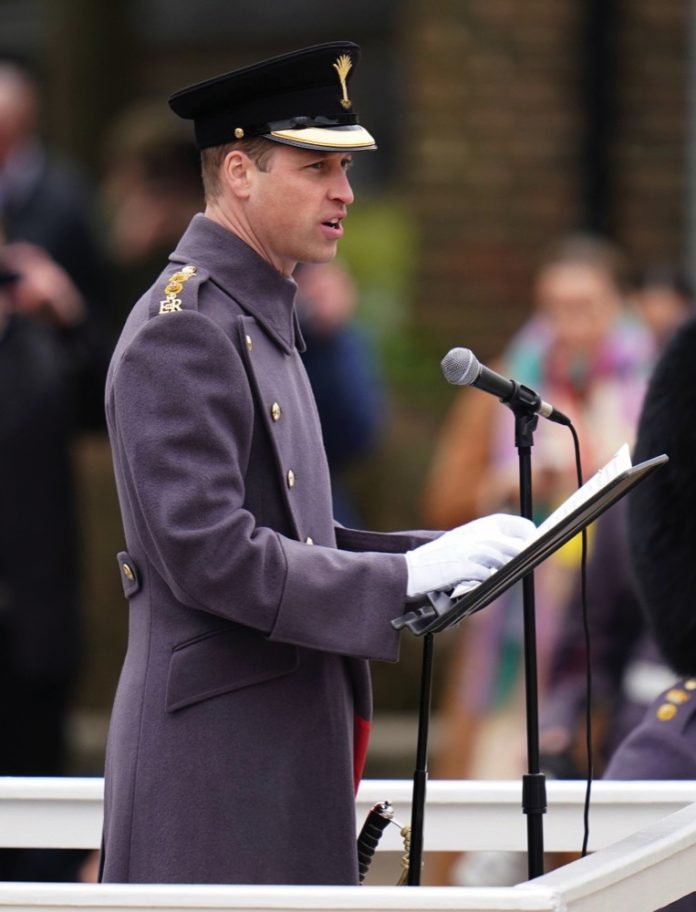
The Prince of Wales, Colonel of the Welsh Guards, gives a speech during a St David's Day visit to the 1st Battalion Welsh Guards at Combermere Barracks in Windsor, Berkshire, March 1, 2023.
THE PRINCE OF WALES AND THE DUKE OF GLOUCESTER WILL ATTEND ANZAC DAY SERVICES
London
Tuesday 25th April 2023
The Prince of Wales and the Duke of Gloucester will attend services commemorating Anzac Day in London on Tuesday 25th April.
Organised by the Australian High Commission in conjunction with the New Zealand High Commission, the Prince of Wales will attend the Dawn Service at the Australia Memorial at Hyde Park Corner.
The Duke of Gloucester will attend the wreath-laying ceremony at the Cenotaph followed by the service of commemoration and thanksgiving at Westminster Abbey.
Anzac Day has been observed in London since King George V attended the first service at Westminster Abbey in 1916 to mark the anniversary of the landings at Gallipoli. Since then, the services have become an important moment to commemorate all Australians and New Zealanders who have lost their lives in conflict and recognise all those who have served. Anzac Day is commemorated as a public holiday in both Australia and New Zealand, with memorial ceremonies held at various locations.
The Dawn Service at Wellington Arch will include readings, the Last Post, a moment of silence, reveille and national anthems. During the service wreaths will be laid by the Prince of Wales and the Australian and New Zealand High Commissioners. The service will conclude with the Prince signing the book of remembrance while music is played on a Didgeridoo. A Māori waiata (song) will also be performed by London-based Ngāti Rānana.
Later in the morning at the wreath-laying ceremony at the Cenotaph, the Duke of Gloucester will lay a wreath and then attend the service of commemoration and thanksgiving at Westminster Abbey. This will be a traditional church service, incorporating an address from the Dean of Westminster and readings from the New Zealand and Australian High Commissioners.
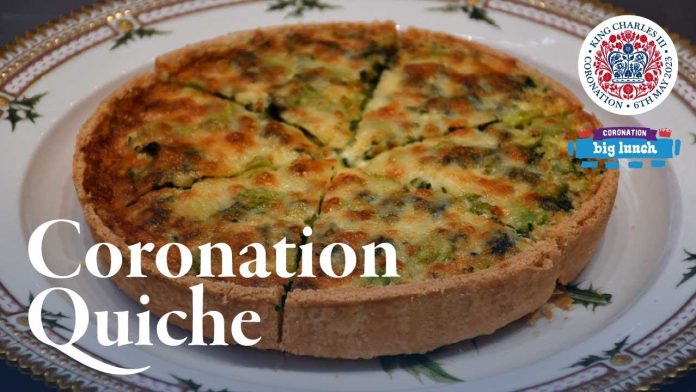
Chosen personally by Their Majesties, The King and The Queen Consort have shared a recipe in celebration of the upcoming Coronation Big Lunches taking place up and down the country.
Easily adapted to different tastes and preferences, the Coronation Quiche – featuring spinach, broad beans, cheese and tarragon – encourages you to get involved with the Coronation Big Lunch!
An initiative by Eden Communities, The Coronation Big Lunch aims to bring neighbours and communities together to celebrate the Coronation and share friendship, food and fun. The Queen Consort, as Patron, has attended Big Lunches all across the UK and the world, including in Ghana and Barbados.
The King and The Queen Consort’s Coronation Quiche – The Royal Family YouTube Channel
Coronation Quiche Recipe
A deep quiche with a crisp, light pastry case and delicate flavours of Spinach, Broad Beans and fresh Tarragon. Eat hot or cold with a green salad and boiled new potatoes – perfect for a Coronation Big Lunch!
x1 20cm Flan Tin
Serves 6
Ingredients
Pastry
125g plain flour
Pinch of salt
25g cold butter, diced
25g lard
2 tablespoons milk
Or 1 x 250g block of ready-made shortcrust pastry
Filling
125ml milk
175ml double cream
2 medium eggs
1 tablespoon chopped fresh tarragon,
Salt and pepper
100g grated cheddar cheese,
180g cooked spinach, lightly chopped
60g cooked broad beans or soya beans
Method
To make the pastry…
Sieve the flour and salt into a bowl; add the fats and rub the mixture together using your finger tips until you get a sandy, breadcrumb like texture.
Add the milk a little at a time and bring the ingredients together into a dough.
Cover and allow to rest in the fridge for 30-45 minutes
Lightly flour the work surface and roll out the pastry to a circle a little larger than the top of the tin and approximately 5mm thick.
Line the tin with the pastry, taking care not to have any holes or the mixture could leak. Cover and rest for a further 30 minutes in the fridge.
Preheat the oven to 190°C.
Line the pastry case with greaseproof paper, add baking beans and bake blind for 15 minutes, before removing the greaseproof paper and baking beans.
Reduce the oven temperature to 160°C.
Beat together the milk, cream, eggs, herbs and seasoning.
Scatter 1/2 of the grated cheese in the blind-baked base, top with the chopped spinach and beans and herbs, then pour over the liquid mixture.
If required gently give the mixture a delicate stir to ensure the filling is evenly dispersed but be careful not to damage the pastry case.
Sprinkle over the remaining cheese. Place into the oven and bake for 20-25 minutes until set and lightly golden.
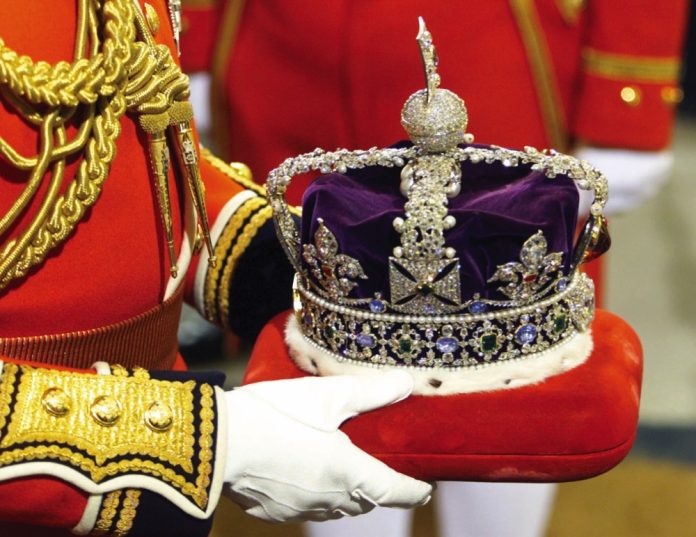
The Imperial State Crown is carried into Parliament through the Sovereigns Entrance of the Palace of Westminster for the Queen to wear during the State Opening of Parliament, 2012.
The Coronation Regalia
9 April 2023
The heart of the Crown Jewels and housed in the Tower of London where they are kept on public display, the Coronation Regalia are sacred and secular objects which symbolise the service and responsibilities of the monarch. The Regalia have played a central role in Coronation Services for hundreds of years and, in keeping with tradition, will be used at Westminster Abbey on the 6 th May. As part of the Royal Collection, the Regalia are held in trust by the Monarch on behalf of the nation.
Two Maces, made of silver gilt over oak, date between 1660 and 1695 and are the ceremonial emblems of authority which are carried before the Sovereign at events such as the State Opening of Parliament. Also carried before the Sovereign on formal occasions is the Sword of State, symbolising Royal authority; a steel blade with a silver-gilt hilt, enclosed in a wooden scabbard which is covered in velvet. In 1660 and 1678, during the reign of King Charles II, two such swords were made, the elder of which has not survived. The remaining sword has been used at several Coronations and, in 1969, the Investiture of The Prince of Wales. The sword is carried with the point upwards, and the scabbard carries the coat of arms of King William III.
Three further swords will be used during the Coronation Procession at Westminster Abbey; the Sword of Temporal Justice, signifying the Monarch’s role as Head of the Armed Forces, the Sword of Spiritual Justice, signifying the Monarch as Defender of the Faith, and the Sword of Mercy or Curtana, which has a blunted tip, symbolising the Sovereign’s mercy. The swords were first used at the Coronation of King Charles I in 1626, and the steel blades date back to the sixteenth century, with early seventeenth century gilt-iron hilts, and wire-bound grips. The three swords are carried without their scabbards, with their points up.
The golden St Edward’s Staff, with its steel spike, was created by the Crown Jeweller, Robert Vyner, in 1661. It derives from an earlier staff which was often referred to as the ‘Long Sceptre’ and carried in fifteenth and sixteenth century Coronation processions as a relic of the Royal saint, Edward the Confessor.
The Chrism oil with which The King and The Queen Consort will be anointed, which was consecrated in The Church of the Holy Sepulchre in Jerusalem in March, will be contained within the Ampulla, made from gold and cast in the form of an eagle with outspread wings. The oil is poured through an aperture in the beak. The Ampulla was supplied for the coronation of King Charles II in 1661 by the Crown Jeweller, Robert Vyner, and is based on an earlier, smaller vessel, which in turn was based on a fourteenth-century legend in which the Virgin Mary appeared to St Thomas à Becket and presented him with a golden eagle and a vial of oil for anointing future Kings of England.
The silver-gilt Coronation Spoon is the oldest object in use at Coronations, having been first recorded in 1349 among St Edward’s Regalia in Westminster Abbey, and is the only piece of Royal goldsmiths’ work to survive from the twelfth century, having possibly been supplied to King Henry II (1133-1189) or King Richard I (1157-1199). It was used to anoint King James I in 1603, and at every subsequent Coronation. In 1649, the Spoon was sold to the Yeoman of King Charles I’s Wardrobe, who returned it for King Charles II’s Coronation in 1661, when small seed pearls were added to the decoration of the handle.
The Spurs were made in 1661 for King Charles II, but the use of spurs at Coronations dates back to King Richard I, the Lionheart, and his Coronation in 1189. The gold, leather and velvet Spurs symbolise knighthood, and they were altered in 1820 for King George IV.
The Sword of Offering was made in 1820, and has a steel blade, mounted in gold and set with jewels, which form a rose, a thistle, a shamrock, oak leaves, acorns, and lion’s heads. The sword is contained in a gold-covered leather scabbard. It was first used at the Coronation of King George IV.
The two Armills are bracelets made from gold, champlevé and basse-taille enamel, lined in velvet, and are thought to relate to ancient symbols of knighthood and military leadership. They have been referred to during previous Coronations as the ‘bracelets of sincerity and wisdom’. The Armills date back to 1661 and have been used at every Coronation from King Charles II’s until King George VI’s in 1937.
A representation of the Sovereign’s power and symbolising the Christian world, the Sovereign’s Orb was made from gold in the seventeenth century, and is divided into three sections with bands of jewels, for each of the three continents known in medieval period.
The Sovereign’s Ring is composed of a sapphire with a ruby cross set in diamonds. A symbol of kingly dignity, the ring was made for the Coronation of King William IV in 1831, and all Sovereigns from King Edward VII onwards have used it at their Coronations.
The two Sovereign’s Sceptres will be used at Coronation. The Sovereign’s Sceptre with Cross represents the sovereign’s temporal power and is associated with good governance. It comprises a gold rod, surmounted by an enamelled heart-shaped structure which holds the Cullinan I diamond. The sceptre was created for King Charles II, and the Cullinan I was added in 1901. The Sovereign’s Sceptre with Dove, traditionally known as ‘the Rod of Equity and Mercy’, represents the Sovereign’s spiritual role, with the enamelled dove with outspread wings representing the Holy Ghost. It was created by the Crown Jeweller, Robert Vyner in 1661.
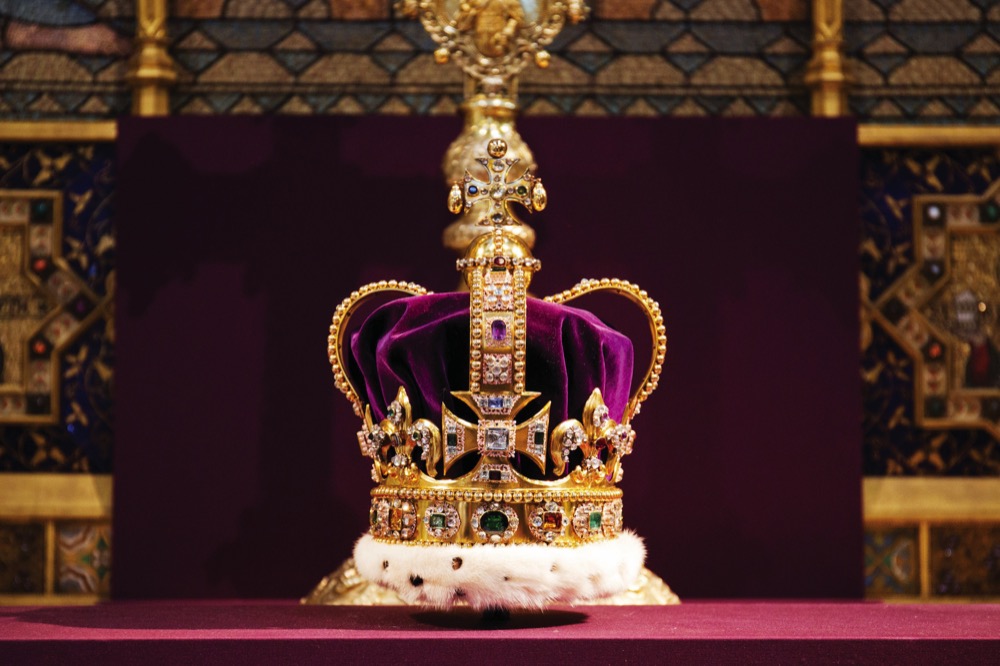
As previously announced, St Edward’s Crown will be used to crown His Majesty The King at Westminster Abbey on 6th May, according to tradition. The crown was made for King Charles II in 1661, as a replacement for the medieval crown which had been melted down in 1649. The original was thought to date back to the eleventh-century royal saint, Edward the Confessor – the last AngloSaxon king of England. The crown was commissioned from the Crown Jeweller, Robert Vyner, in 1661. Although it is not an exact replica of the medieval design, it follows the original in having four crosses-pattée and four fleurs-de-lis, and two arches. The crown is topped with an orb and a cross, symbolising the Christian world, and is made up of a solid gold frame set with rubies, amethysts, sapphires, garnet, topazes and tourmalines. The crown has a velvet cap with an ermine band. St Edward’s Crown was worn by Queen Elizabeth II at the Coronation in 1953. The crown has been removed from the Tower of London to allow for modification work ahead of the Coronation.
St Edward’s Crown
The Queen Consort’s Ring, a ruby in a gold setting, was made for the Coronation of King William IV and Queen Adelaide in 1831, and has been used by three further Queens Consort; Queen Alexandra, Queen Mary, and Queen Elizabeth The Queen Mother.
Mirroring the Sovereign’s Sceptre with Dove, the Queen Consort’s Rod with Dove is symbolic of ‘equity and mercy’ and the dove, with its folded wings, is symbolic of the Holy Ghost. The Queen Consort’s Sceptre with Cross was originally supplied for the coronation of Mary of Modena, Queen Consort of James II, in 1685 by Robert Vyner, and is inlaid with rock crystals.
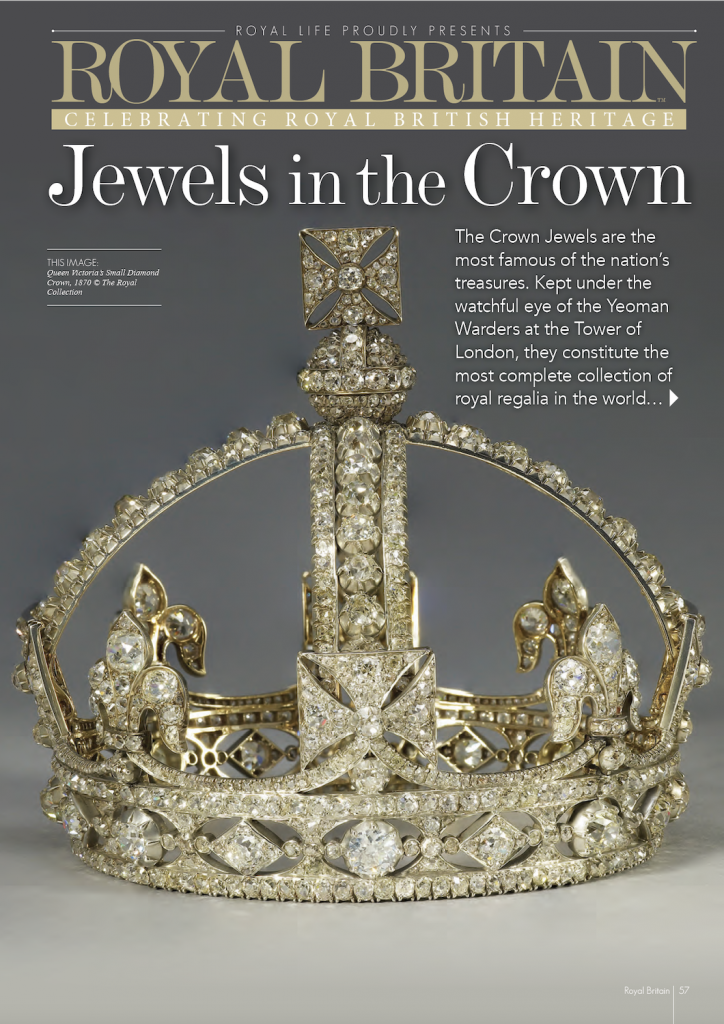
Queen Mary’s Crown has been chosen by The Queen Consort for the Coronation, as previously announced, marking the first instance in modern times of an existing crown being used for the Coronation of the Consort. Ahead of the Coronation, minor changes and additions to Queen Mary’s Crown are being undertaken, such as the as inclusion of the Cullinan III, IV and V diamonds which were part of Queen Elizabeth II’s personal jewellery collection for many years. The design was inspired by Queen Alexandra’s Crown of 1902. Like Queen Alexandra’s Crown, it can be worn without the arches in the form of a circlet, which Queen Mary wore for the Coronation of her son, King George VI, in 1937.
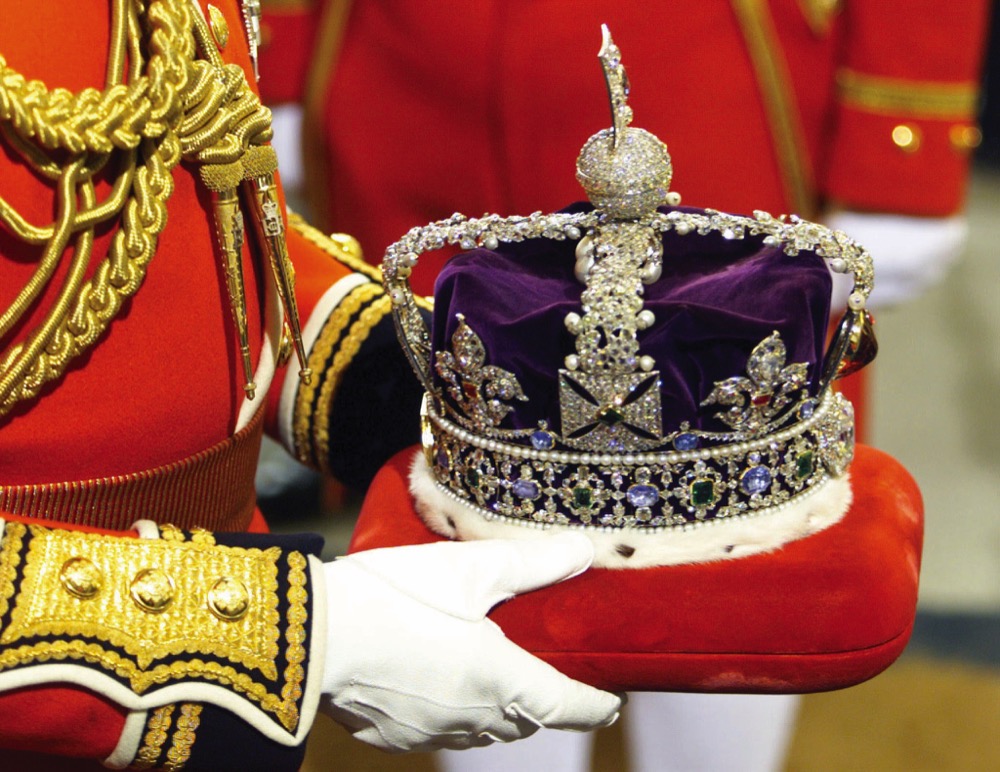
The Imperial State Crown is carried into Parliament through the Sovereigns Entrance of the Palace of Westminster for the Queen to wear during the State Opening of Parliament, 2012.
The Imperial State Crown, or Crown of State, is the crown the monarch exchanges for St Edward’s Crown at the end of the Coronation Service. The Imperial State Crown is also used on ceremonial occasions, such as the State Opening of Parliament. The term “imperial state crown” dates back to the fifteenth century when English monarchs chose a crown design closed by arches to demonstrate that England was not subject to any other earthly power. This Imperial State Crown was made for the Coronation of King George VI in 1937, but is closely based on a crown designed for Queen Victoria in 1838 by the Crown Jewellers of the time, Rundell, Bridge & Rundell.
The Golden State Coach at St Paul's Cathedral after arriving with the Queen and Duke of Edinburgh to attend a special service of thanksgiving for the Silver Jubilee.
The Coronation Procession
9 April 2023
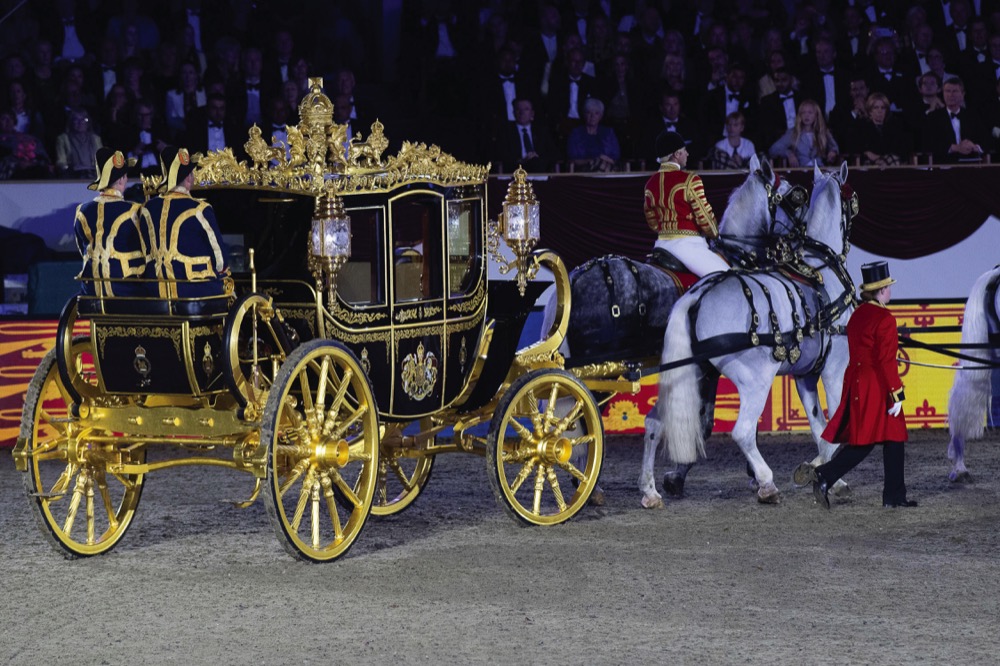
On the morning of the 6th May, Their Majesties will travel from Buckingham Palace in The King’s Procession to Westminster Abbey in the Diamond Jubilee State Coach. Created for Queen Elizabeth II to commemorate the 60th anniversary of Her late Majesty’s reign in 2012, the coach has only ever conveyed the Sovereign, occasionally accompanied by the consort or a visiting Head of State.
The Irish, Scottish and Diamond Jubilee State Coaches. Guests were thrilled to watch the Platinum Jubilee Celebration in the presence of The Princess Royal in the private grounds of Windsor Castle. 500 horses and 1,300 participants from across the Commonwealth and the World took part in the theatrical event entitled A Gallop Through History to celebrate the Reign of Her Majesty the Queen, 2022.
The gilded crown on the top of the Diamond Jubilee State Coach was carved from oak from HMS Victory, and the coach’s interior is inlaid with samples of woods, metals and other materials from buildings and places with specific connections to Britain and its history; Royal Residences including Buckingham Palace, Kensington Palace, Windsor Castle and the Palace of Holyroodhouse; cathedrals including St Paul’s and Westminster Abbey; and historic ships, such as the Mary Rose. The coach will be drawn by six Windsor Greys.
The King’s Procession, accompanied by The Sovereign’s Escort of the Household Cavalry, will depart Buckingham Palace through the Centre Gate, and proceed down The Mall, passing through Admiralty Arch and south of King Charles I Island, down Whitehall and along Parliament Street. The King’s Procession will travel around the east and south sides of Parliament Square to Broad Sanctuary to arrive at the Sanctuary of Westminster Abbey, where the Coronation Service will begin at 11 o’clock.
The procession from Westminster Abbey to Buckingham Palace, The Coronation Procession, will be much larger in scale, taking the same route in reverse. The Coronation Procession will include Armed Forces from across the Commonwealth and the British Overseas Territories, and all Services of the Armed Forces of the United Kingdom, alongside The Sovereign’s Bodyguard and Royal Watermen.
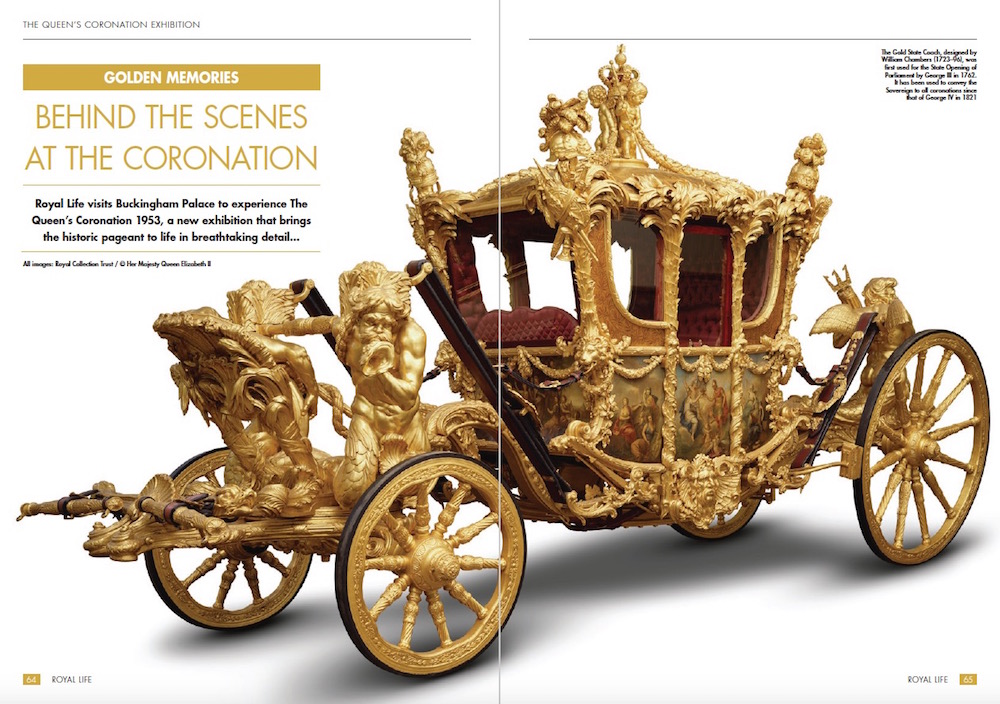
The Golden State coach, bearing Queen Elizabeth II and the Duke of Edinburgh, on her from Westminster Abbey to Buckingham Palace after her Coronation.
Their Majesties will travel in the Gold State Coach. The coach, last seen during the Pageant of the Platinum Jubilee of Queen Elizabeth II in June 2022, was commissioned in 1760 and was first used by King George III, to travel to the State Opening of Parliament in 1762. The coach has been used at every Coronation since that of William IV in 1831. The coach will be drawn by eight Windsor Greys and, due to its weight of four tonnes, will travel at walking pace.
Upon returning to Buckingham Palace following the Coronation Service, Their Majesties will receive a Royal Salute from the United Kingdom and Commonwealth Armed Forces who have been on parade that day. The Royal Salute will be followed by three cheers from the assembled service personnel, as a tribute from the Armed Forces on parade to The King and The Queen Consort on the day of Their Majesties’ Coronation.
Learn more behind-the-scene facts from Her Majesty Queen Elizabeth II’s 1953 Coronation in Royal Life Magazine – Issue 6
The Prince of Wales (now King Charles) presents Officer Cadet Michael Lomando of the USA the Overesas award during the Sovereign's Parade at the Royal Military Academy Sandhurst, 2015
HIS MAJESTY THE KING WILL INSPECT THE 200TH SOVEREIGN’S PARADE AT THE ROYAL MILITARY ACADEMY SANDHURST
Friday 14th April 2023
His Majesty The King will inspect the 200th Sovereign’s Parade, presenting the new colours and Sovereign’s Banner to the receiving ensigns. The King will give an address and present awards, including the Sword of Honour.
During the 200th parade, 171 officer cadets will be commissioning as army officers. The parade marks completion of 44 weeks of intensive training for the officer cadets, all of whom will hold His Majesty’s commission as of midnight on the day of the parade.
Upon arrival His Majesty will be invited to inspect officer cadets of the senior division, those who will be graduating as commissioned officers and the front ranks of the junior and intermediate divisions.
Among those on parade will be 26 international cadets from 15 countries who will become commissioned officers in their new countries.
Taking centre stage, the new colours and Sovereign’s Banner will be marched out of Old College. Once blessed by the Chaplain General, the King will step forward and, escorted by Commandants of Old and New Colleges, will present the new colours and the Sovereign’s Banner to the receiving ensigns.
The old colours, belonging to Her Late Majesty, will be marched on to the parade with the cadets passing the statue of Queen Elizabeth II, at which point a salute will be given.
Following the presentation of colours, the King will give an address and present awards, including the Sword of Honour.
As the parade concludes His Majesty will move to the Indian Army Memorial Room, to meet the prizewinners and a selection of foreign officer cadets.
Upon departure, the Commandant will present the King with a gift at the base of Old College Steps.
As Prince of Wales, His Majesty last attended the Sovereign’s Parade in December 2015, representing Her late Majesty Queen Elizabeth II.
Sandhurst
The original Royal Military Academy (RMA) was established at Woolwich for the training of artillery and engineer officers in 1741. Cavalry and infantry officers were trained at the Royal Military College (RMC), which was founded in 1802 and moved to Sandhurst in 1812. The RMA and RMC merged after the Second World War to form the present establishment, the Royal Military Academy Sandhurst (RMAS).
The first commissioning parade of the new RMAS was held in 1948 in the presence of His Majesty King George VI, who decreed henceforth that the parade was to be known as The Sovereign’s Parade.
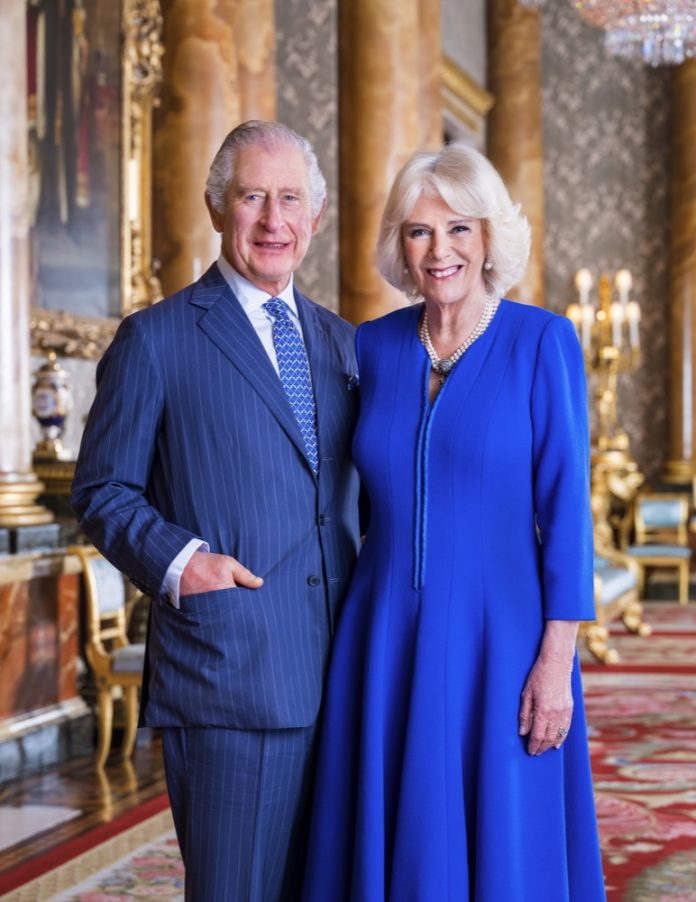
A new photograph of Their Majesties The King and The Queen Consort, taken last month in the Blue Drawing Room at Buckingham Palace, has been released today, Tuesday 4 April. The photograph was taken by Hugo Burnand.
A New Photograph of The King and The Queen Consort
4 April 2023
A new photograph of Their Majesties The King and The Queen Consort, taken last month in the Blue Drawing Room at Buckingham Palace, has been released today, Tuesday 4 April. The photograph was taken by Hugo Burnand.
Alongside the photograph, Buckingham Palace is pleased to share the invitation for the Coronation, which will be issued in due course to over 2,000 guests who will form the congregation in Westminster Abbey. It is also announced today that eight Pages of Honour have been chosen to attend Their Majesties during the Coronation Service.
Buckingham Palace is pleased to share the invitation for the Coronation, which will be issued in due course to over 2,000 guests who will form the congregation in Westminster Abbey.
The invitation for the Coronation has been designed by Andrew Jamieson, a heraldic artist and manuscript illuminator whose work is inspired by the chivalric themes of Arthurian legend. Mr Jamieson is a Brother of the Art Workers’ Guild, of which The King is an Honorary Member.
The original artwork for the invitation was hand-painted in watercolour and gouache, and the design will be reproduced and printed on recycled card, with gold foil detailing. Central to the design is the motif of the Green Man, an ancient figure from British folklore, symbolic of spring and rebirth, to celebrate the new reign. The shape of the Green Man, crowned in natural foliage, is formed of leaves of oak, ivy and hawthorn, and the emblematic flowers of the United Kingdom.
The British wildflower meadow bordering the invitation features lily of the valley, cornflowers, wild strawberries, dog roses, bluebells, and a sprig of rosemary for remembrance, together with wildlife including a bee, a butterfly, a ladybird, a wren and a robin. Flowers appear in groupings of three, signifying The King becoming the third monarch of his name.
A lion, a unicorn and a boar – taken from the coats of arms of the Monarch and Her Majesty’s father, Major Bruce Shand – can be seen amongst the flowers. Her Majesty’s arms are now enclosed by the Garter, following her installation as a Royal Lady of the Order of the Garter last summer.
Throughout the Coronation Service on 6th May, Their Majesties will each be attended by four Pages of Honour. The Pages will form part of the procession through the Nave of Westminster Abbey.
The King’s Pages of Honour will be His Royal Highness Prince George of Wales, Lord Oliver Cholmondeley, Master Nicholas Barclay and Master Ralph Tollemache.
The Queen Consort’s Pages of Honour will be Her Majesty’s grandsons, Master Gus and Master Louis Lopes and Master Freddy Parker Bowles, and Her Majesty’s great-nephew, Master Arthur Elliot.
Sir David Attenborough Opens New Platinum Jubilee Woodland
Sir David Attenborough Opens New Platinum Jubilee Woodland
Monday, 20 March 2023
Sir David Attenborough has planted an English oak tree to officially open the Platinum Jubilee Woodland, a new woodland in Richmond Park planted as part of The Queen’s Green Canopy initiative, today, (Monday 20 March). He was joined by several children from the local area.
The woodland has been planted to celebrate and honour the late Queen Elizabeth II’s lifetime of service.
The tree, chosen by Sir David, is one of the final few to be planted as part of The Queen’s Green Canopy initiative, which concludes on 31 March – the end of the planting season in the UK. The project invited people from across the nation to plant trees in honour of Queen Elizabeth II to mark the Platinum Jubilee and benefit future generations.
In all, 70 young broadleaved trees have been planted in the woodland, with help from volunteers and people from the local community, to represent each year of Her Late Majesty’s reign. They include oak, Dutch elm-disease-resistant elm, small-leaved lime, and sweet chestnut trees. They are planted around a focal point which will later incorporate a seating area for rest and reflection. These larger canopy trees are complemented by smaller native trees and hedging such as hawthorn, blackthorn, hazel, elder and dogwood.
The woodland provides respite for visitors and creates new habitat to support wildlife, including the endangered white-letter hairstreak butterfly and the cardinal click beetle. The shrubs will also provide shelter and a food source for small mammals and invertebrates.
Sir David Attenborough, Patron of The Friends of Richmond Park charity, and Queen’s Green Canopy Ambassador, said: “I am thrilled to be opening this new woodland to honour and celebrate Queen Elizabeth II’s Platinum Jubilee and life of service. The late Queen was very fond of The Royal Parks and was a great lover of trees, so this is a fitting tribute to her memory. Its creation also marks the continuing conservation of this protected landscape, and the wonderful wildlife within, so that it can be enjoyed by many generations to come.”
“The Queen’s Green Canopy has created an invaluable national legacy for our children, future generations and the planet itself.”
Paul Richards, Richmond Park Manager, added: “This tranquil new woodland marks 70 years of Queen Elizabeth II’s reign by providing a welcoming community space for all.
“We hope that by enhancing the rich diversity of wildlife within this important National Nature Reserve, the woodland will inspire discovery and enjoyment of the natural environment for future generations – and that our youngest visitors especially will enjoy returning over the decades to notice the changes in the woodland as the trees mature.”
Roger Hillyer, Chair of the Friends of Richmond Park, said: “The Friends of Richmond Park are delighted to support the creation of this new woodland as a legacy in honour of Her Late Majesty Queen Elizabeth II. Today’s planting by Sir David and school children from the Friends Discoverers educational programme will enhance the diversity of this much-loved National Nature Reserve.”
Charlotte Cass, Help Nature Thrive Project Manager, said: “It was wonderful to see so many local people from across the generations making a positive difference to Richmond Park on our Queen’s Green Canopy planting day. We’re grateful to players of People’s Postcode Lottery, and everyone involved, for bringing together local communities to plant woodland that they can watch grow for years to come.”
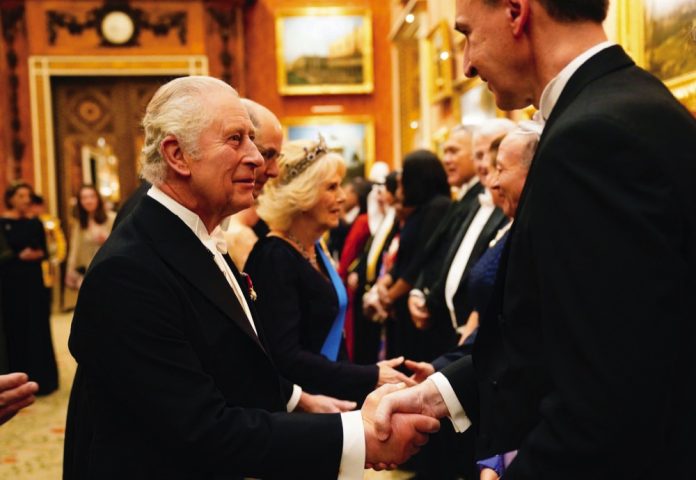
King Charles III during a Diplomatic Corps reception at Buckingham Palace in London. December 6, 2022.
HIS MAJESTY THE KING IS ANNOUNCED AS COLONEL-IN-CHIEF OF THE CORPS OF ROYAL ENGINEERS
28 March 2023
His Majesty The King is today announced as Colonel in Chief of the Corps of Royal Engineers. Her Majesty Queen Elizabeth II was the previous Colonel in Chief. Commonly known as the Sappers, the corps was founded in 1716 and gained the prefix royal in 1787. They operate at the forefront of innovation to provide global military engineering and technical support to the British Armed Forces and their allies.
During Their Majesties’ state visit to Germany, starting tomorrow, the King will meet representatives from the Corps of Royal Engineers, in Brandenburg to view a demonstration of a wide river pontoon bridging by 23 Amphibious Engineer Squadron.
On Tuesday 14th March 2023 His Majesty received Lieutenant General Sir Tyrone Urch KBE (Chief Royal Engineer) at Buckingham Palace.
“I am absolutely delighted that His Majesty The King has agreed to be our new Colonel-in-Chief,’ said the Chief Royal Engineer. “This is a great honour and continues a long-standing tradition started in 1904 by His Majesty King Edward VII. This wonderful news will inspire the entire Sapper family worldwide.”
All Royal Engineers are ‘triple traded’, or possess three trades; soldiers first, then combat engineers (trained as field engineers or demolition experts, or similar) and then tradespeople (carpenter, mechanic, driver, communications technician, covering a total of 26 trades).
Most recently the corps has been deployed in a wide variety of roles from Estonia, Poland and Cyprus to providing training in Mali, and here in the UK. Royal Engineer Units and Queens Ghurka Engineers have also guarded the royal palaces this year and will support Their Majesties’ coronation.
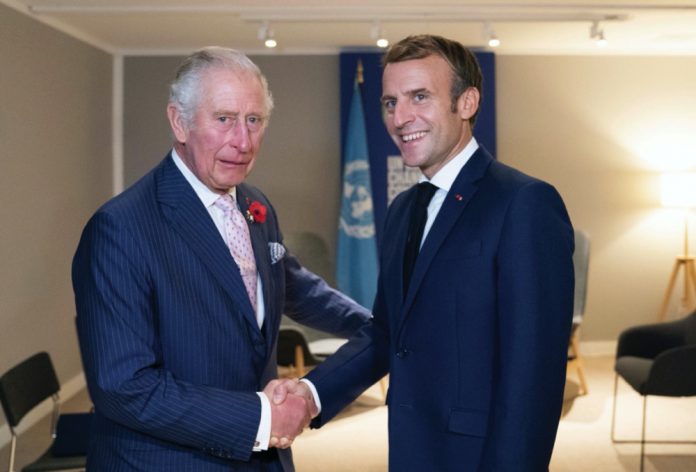
The Prince of Wales greets the President of France Emmanuel Macron ahead of their bilateral during the Cop26 summit at the Scottish Event Campus (SEC) in Glasgow, November 1, 2021.
The King and The Queen Consort will undertake State Visits to France and Germany
3 March 2023
The King and The Queen Consort’s first State Visit of the new reign, to France and Germany, will take place from Sunday 26th March to Friday 31st March 2023.
The visit will celebrate Britain’s relationship with France and Germany, marking our shared histories, culture and values. It will also provide an opportunity to look forwards and demonstrate the many ways the UK is working in partnership with France and Germany, whether that be to tackle climate change; respond to the conflict in Ukraine; seize trade and investment opportunities or share the best of our arts and culture.
As well as speaking to the strength of the UK’s bilateral relationships with France and Germany, Their Majesties’ visits will include engagements highlighting the importance of sustainability and community – key themes which have been embraced by citizens of all our countries. There will also be opportunities to reflect on the sacrifices and challenges of our shared past, out of which has come an enduring legacy of cooperation and reconciliation.
The State Visit Programme
Their Majesties will travel to France on Sunday 26th March until Wednesday 29th, undertaking engagements in Paris during that time and on Tuesday 28th, visiting Bordeaux.
Highlights of their French programme will include:
The King and The Queen Consort will join President and Mrs. Macron for a ceremony of Remembrance and wreath laying at the Arc de Triomphe;
His Majesty will address Senators and members of the National Assembly at the French Senate;
Her Majesty, together with Mrs. Macron, will officially open the new Manet and Degas exhibition at the Musée d’Orsay;
Their Majesties will be guests of honour at a State Banquet hosted by President and Mrs. Macron at the Chateau de Versailles;
His Majesty will witness first-hand the devastation caused by last summer’s wildfires on the outskirts of Bordeaux, hearing from emergency workers and the local community about their experiences;
Their Majesties will mark the opening of the British Consulate in Bordeaux and meet members of the local French and British communities;
The Royal couple will tour an organic vineyard, which has pioneered a sustainable approach to wine making.
Their Majesties will arrive in Berlin on Wednesday 29th March. On Thursday 30th, they will undertake engagements in Berlin and Brandenburg, before heading to Hamburg on Friday 31st March.
In Germany, highlights of their programme include:
A ceremonial welcome by President Steinmeier and Frau Büdenbender at the Brandenburg Gate;
Their Majesties will be guests of honour at a State Banquet, hosted by the President and his wife at Schloss Bellevue;
His Majesty will address the Bundestag, the German Federal Parliament;
His Majesty will meet refugees recently arrived from Ukraine and hear about the support Germany provides for them;
Her Majesty, accompanied by Frau Büdenbender, will visit the Komische Oper in Berlin, to learn more about the opera company’s outreach projects and community engagement;
In Brandenburg, His Majesty will meet representatives from a joint German/U.K. military unit and see a demonstration of their bridge-building amphibious vehicles;
In Hamburg, Their Majesties will visit the St. Nikolai Memorial, the remains of a church which was destroyed when the Allies bombed the city during the Second World War. His Majesty and the President will lay wreaths during a short ceremony of remembrance.
His Majesty will learn more about the port of Hamburg’s adoption of green technologies, meeting representatives from some of the firms involved.
The King and The Queen Consort will attend a celebratory reception with Hamburg residents and members of the local British community, accompanied by the President and Frau Büdenbender, marking the end of their State Visit.
UPDATE: THE KING AND QUEEN’S STATE VISIT TO FRANCE
The King and Queen’s state visit to France, due to start on Sunday, has been postponed.
Buckingham Palace: ‘Their Majesties greatly look forward to the opportunity to visit France as soon as dates can be found.’
The state visit to Germany next week will proceed as planned.
We use cookies on our website to give you the most relevant experience by remembering your preferences and repeat visits. By clicking “Accept All”, you consent to the use of ALL the cookies. However, you may visit "Cookie Settings" to provide a controlled consent.
This website uses cookies to improve your experience while you navigate through the website. Out of these, the cookies that are categorized as necessary are stored on your browser as they are essential for the working of basic functionalities of the website. We also use third-party cookies that help us analyze and understand how you use this website. These cookies will be stored in your browser only with your consent. You also have the option to opt-out of these cookies. But opting out of some of these cookies may affect your browsing experience.
Necessary cookies are absolutely essential for the website to function properly. These cookies ensure basic functionalities and security features of the website, anonymously.
Cookie
Duration
Description
_GRECAPTCHA
5 months 27 days
This cookie is set by the Google recaptcha service to identify bots to protect the website against malicious spam attacks.
cookielawinfo-checkbox-advertisement
1 year
Set by the GDPR Cookie Consent plugin, this cookie is used to record the user consent for the cookies in the "Advertisement" category .
cookielawinfo-checkbox-analytics
11 months
This cookie is set by GDPR Cookie Consent plugin. The cookie is used to store the user consent for the cookies in the category "Analytics".
cookielawinfo-checkbox-functional
11 months
The cookie is set by GDPR cookie consent to record the user consent for the cookies in the category "Functional".
cookielawinfo-checkbox-necessary
11 months
This cookie is set by GDPR Cookie Consent plugin. The cookies is used to store the user consent for the cookies in the category "Necessary".
cookielawinfo-checkbox-others
11 months
This cookie is set by GDPR Cookie Consent plugin. The cookie is used to store the user consent for the cookies in the category "Other.
cookielawinfo-checkbox-performance
11 months
This cookie is set by GDPR Cookie Consent plugin. The cookie is used to store the user consent for the cookies in the category "Performance".
CookieLawInfoConsent
1 year
Records the default button state of the corresponding category & the status of CCPA. It works only in coordination with the primary cookie.
enforce_policy
1 year
PayPal sets this cookie for secure transactions.
rc::a
never
This cookie is set by the Google recaptcha service to identify bots to protect the website against malicious spam attacks.
rc::b
session
This cookie is set by the Google recaptcha service to identify bots to protect the website against malicious spam attacks.
rc::c
session
This cookie is set by the Google recaptcha service to identify bots to protect the website against malicious spam attacks.
rc::f
never
This cookie is set by the Google recaptcha service to identify bots to protect the website against malicious spam attacks.
ts
1 year 1 month 4 days
PayPal sets this cookie to enable secure transactions through PayPal.
ts_c
1 year 1 month 4 days
PayPal sets this cookie to make safe payments through PayPal.
viewed_cookie_policy
11 months
The cookie is set by the GDPR Cookie Consent plugin and is used to store whether or not user has consented to the use of cookies. It does not store any personal data.
wpEmojiSettingsSupports
session
WordPress sets this cookie when a user interacts with emojis on a WordPress site. It helps determine if the user's browser can display emojis properly.
Functional cookies help to perform certain functionalities like sharing the content of the website on social media platforms, collect feedbacks, and other third-party features.
Cookie
Duration
Description
LANG
9 hours
Linkedin set this cookie to set user's preferred language.
nsid
session
PayPal sets this cookie to enable the PayPal payment service on the website.
tsrce
3 days
PayPal sets this cookie to enable the PayPal payment service on the website.
x-pp-s
session
PayPal sets this cookie to process payments on the site.
yt-remote-cast-installed
session
The yt-remote-cast-installed cookie is used to store the user's video player preferences using embedded YouTube video.
yt-remote-fast-check-period
session
The yt-remote-fast-check-period cookie is used by YouTube to store the user's video player preferences for embedded YouTube videos.
yt-remote-session-app
session
The yt-remote-session-app cookie is used by YouTube to store user preferences and information about the interface of the embedded YouTube video player.
yt-remote-session-name
session
The yt-remote-session-name cookie is used by YouTube to store the user's video player preferences using embedded YouTube video.
ytidb::LAST_RESULT_ENTRY_KEY
never
The cookie ytidb::LAST_RESULT_ENTRY_KEY is used by YouTube to store the last search result entry that was clicked by the user. This information is used to improve the user experience by providing more relevant search results in the future.
Performance cookies are used to understand and analyze the key performance indexes of the website which helps in delivering a better user experience for the visitors.
Cookie
Duration
Description
_gat
1 minute
This cookie is installed by Google Universal Analytics to restrain request rate and thus limit the collection of data on high traffic sites.
l7_az
1 hour
This cookie is necessary for the PayPal login function on the website.
Analytical cookies are used to understand how visitors interact with the website. These cookies help provide information on metrics the number of visitors, bounce rate, traffic source, etc.
Cookie
Duration
Description
_ga
2 years
The _ga cookie, installed by Google Analytics, calculates visitor, session and campaign data and also keeps track of site usage for the site's analytics report. The cookie stores information anonymously and assigns a randomly generated number to recognize unique visitors.
_ga_*
1 year 1 month 4 days
Google Analytics sets this cookie to store and count page views.
_gid
1 day
Installed by Google Analytics, _gid cookie stores information on how visitors use a website, while also creating an analytics report of the website's performance. Some of the data that are collected include the number of visitors, their source, and the pages they visit anonymously.
CONSENT
2 years
YouTube sets this cookie via embedded youtube-videos and registers anonymous statistical data.
sbjs_current
session
Sourcebuster sets this cookie to identify the source of a visit and stores user action information in cookies. This analytical and behavioural cookie is used to enhance the visitor experience on the website.
sbjs_current_add
session
Sourcebuster sets this cookie to identify the source of a visit and stores user action information in cookies. This analytical and behavioural cookie is used to enhance the visitor experience on the website.
sbjs_first
session
Sourcebuster sets this cookie to identify the source of a visit and stores user action information in cookies. This analytical and behavioural cookie is used to enhance the visitor experience on the website.
sbjs_first_add
session
Sourcebuster sets this cookie to identify the source of a visit and stores user action information in cookies. This analytical and behavioural cookie is used to enhance the visitor experience on the website.
sbjs_migrations
session
Sourcebuster sets this cookie to identify the source of a visit and stores user action information in cookies. This analytical and behavioural cookie is used to enhance the visitor experience on the website.
sbjs_session
1 hour
Sourcebuster sets this cookie to identify the source of a visit and stores user action information in cookies. This analytical and behavioural cookie is used to enhance the visitor experience on the website.
sbjs_udata
session
Sourcebuster sets this cookie to identify the source of a visit and stores user action information in cookies. This analytical and behavioural cookie is used to enhance the visitor experience on the website.
Advertisement cookies are used to provide visitors with relevant ads and marketing campaigns. These cookies track visitors across websites and collect information to provide customized ads.
Cookie
Duration
Description
guest_id
1 year 1 month
Twitter sets this cookie to identify and track the website visitor. It registers if a user is signed in to the Twitter platform and collects information about ad preferences.
NID
6 months
NID cookie, set by Google, is used for advertising purposes; to limit the number of times the user sees an ad, to mute unwanted ads, and to measure the effectiveness of ads.
VISITOR_INFO1_LIVE
5 months 27 days
A cookie set by YouTube to measure bandwidth that determines whether the user gets the new or old player interface.
VISITOR_PRIVACY_METADATA
6 months
YouTube sets this cookie to store the user's cookie consent state for the current domain.
YSC
session
YSC cookie is set by Youtube and is used to track the views of embedded videos on Youtube pages.
yt-remote-connected-devices
never
YouTube sets this cookie to store the video preferences of the user using embedded YouTube video.
yt-remote-device-id
never
YouTube sets this cookie to store the video preferences of the user using embedded YouTube video.
yt.innertube::nextId
never
This cookie, set by YouTube, registers a unique ID to store data on what videos from YouTube the user has seen.
yt.innertube::requests
never
This cookie, set by YouTube, registers a unique ID to store data on what videos from YouTube the user has seen.